
Davidson County Court Records After Arrest
A Davidson County arrest normally creates two related record paths. The jail path starts with booking at the Davidson County Jail and may appear on the sheriff's active inmate list or active inmate offense PDF. The court path begins when criminal process, release conditions, and filed charges move through the North Carolina Judicial Branch system. Davidson County is in Prosecutorial District 33, and the official District Attorney page lists Garry Frank as the District Attorney for Davidson and Davie counties.
Booking records are not the same as court records after a jail arrest. The jail roster can help confirm current custody, booking number, name number, statute, offense, court code, and felony or misdemeanor class. The court record is where a defendant's case number, charging document, hearing schedule, amendments, dismissals, pleas, verdicts, and dispositions are tracked. For custody and booking fields, use Davidson County jail inmate records. For booking photos and photo requests, use Davidson County jail mugshots.
Find Davidson County Court Records After Arrest
The official court search channel is the North Carolina Judicial Branch Portal, which the state describes as a way to search case information, court dates, and payments. The Judicial Branch also says people performing background checks should use the county clerk's office rather than relying only on Portal case lookups. Davidson County court business is tied to the courthouse at 110 West Center Street in Lexington, with the Clerk of Superior Court listed at 336-242-6701.
- Search the North Carolina Judicial Branch Portal by name, case number, citation, attorney, or hearing information when available.
- Open the Davidson County case entry and compare the defendant name, charge, case number, and hearing date.
- Check whether the charge is pending, amended, dismissed, reduced, or disposed.
- Contact the Davidson County Clerk of Superior Court for certified searches, older records, or paper copies.
- Use the jail roster only for current custody, booking status, and jail-facing offense fields.
Davidson County Court Search Fields
The court portal is dynamic, so the research file uses the North Carolina Judicial Branch descriptions rather than a complete HTML form capture. Those descriptions still identify the practical search paths for court records after an arrest in Davidson County.
| Field Label | Type | Required | Notes |
|---|---|---|---|
| Name | Search / smart search | Unspecified | NC courts says Portal allows name searches for case information and hearing dates. |
| Attorney | Search option | Optional | Useful when counsel is known. |
| Citation | Search option | Optional | May apply to traffic or citation-based matters. |
| Case number | Search option | Optional | Best when a case number is already known. |
| Court dates / hearings | Tab or search area | Optional | Portal can locate hearing information. |
| Payments | Service area | Optional | Portal can handle certain payments. |
Davidson County Court Records Source
The North Carolina Judicial Branch Davidson County page identifies Davidson County as Prosecutorial District 33, Superior Court District 33, and District Court District 33.
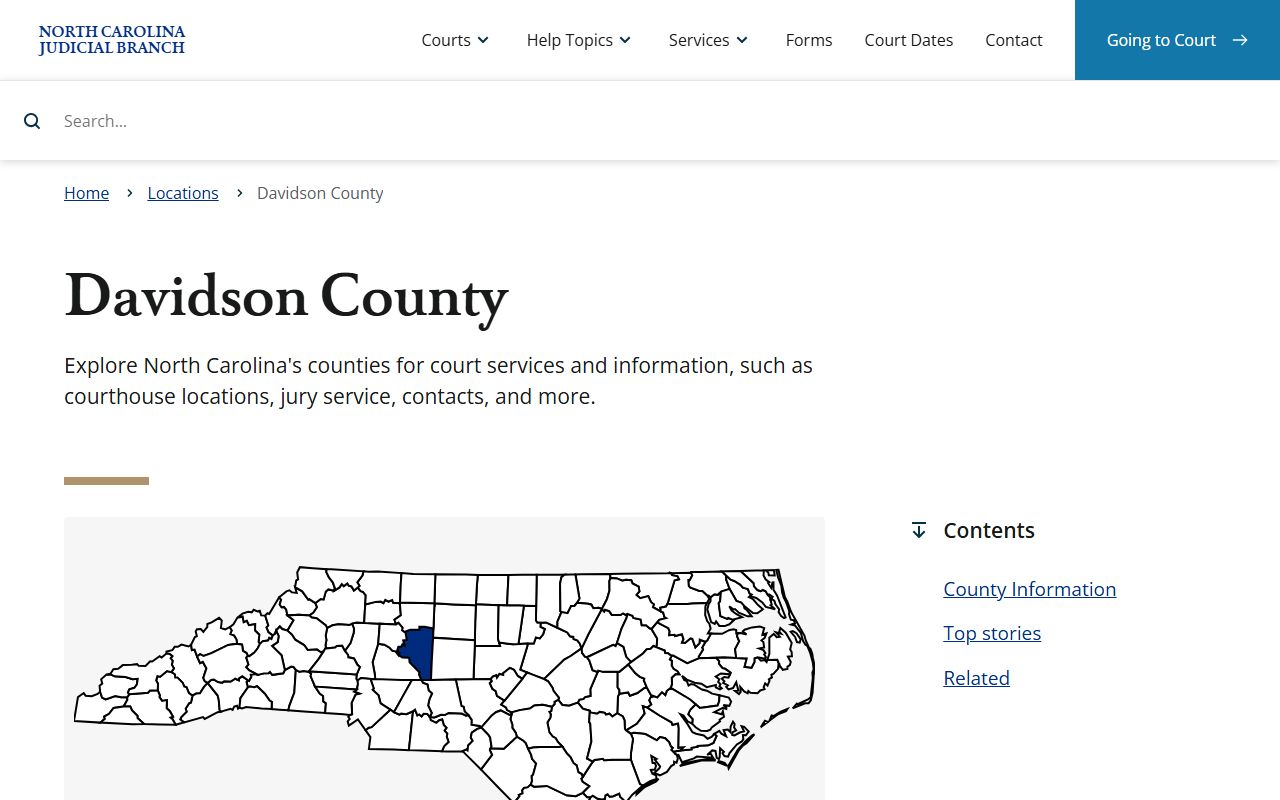
That state court page is the right government starting point for court records after a Davidson County jail arrest because it leads to courthouse, directory, and Portal resources.
Charges Filed After Davidson County Arrest
A jail entry may show the offense that led to custody, but the prosecutor and court system control the formal case path. Misdemeanors and lower-level matters may proceed in district court on warrant, magistrate order, citation, or similar process. Felony cases often begin with arrest process and first appearance, then may move through probable cause, bind-over, or indictment in superior court. The exact path depends on the charge and prosecutorial action.
| Document Type | How It Works in Plain Terms | Common Use |
|---|---|---|
| Complaint or warrant-style process | Starts or supports a criminal accusation after arrest or service of process. | Misdemeanors and many lower-level matters. |
| Information | A prosecutor-filed charge document used when the case path allows it. | Some felony or negotiated matters, depending on procedure. |
| Indictment | A grand jury charging document used to move felony charges in superior court. | Serious felony prosecution. |
Davidson County Charge Status
Charge status can change after the first jail record appears. A prosecutor may dismiss, amend, reduce, add, or supersede a charge. A court may set a hearing, continue the case, enter a plea, hold a trial, or enter a final disposition. The active inmate offense list should be treated as a custody and offense snapshot, not a complete criminal history.
| Status | What It Means |
|---|---|
| Pending | The case or charge remains open and has not reached final disposition. |
| Amended | The charge was changed, corrected, replaced, or updated by court or prosecutor action. |
| Reduced | The charge level or offense was lowered, often through plea or prosecutor action. |
| Dismissed | The charge was ended without a conviction on that count. |
| Disposed | The court entered an outcome such as plea, verdict, dismissal, or other final action. |
Bond After Davidson County Arrest
North Carolina bond decisions for Davidson County cases are governed by N.C.G.S. 15A-534. A judicial official must impose at least one condition of pretrial release, such as an unsecured appearance bond, custody of a designated person or organization, secured bond backed by cash, property or surety, or house arrest with electronic monitoring. The court considers the charge, evidence, family ties, employment, financial resources, character, housing, mental condition, local residence, flight history, and other reliable information.
| Release Term | Meaning |
|---|---|
| Unsecured bond | A promised amount owed if court conditions are not met. |
| Secured bond | Release backed by cash, property, mortgage, or surety. |
| Surety | A bail agent or financially responsible person backs the bond. |
| No-bond hold | Release is not authorized until a court action or hold is resolved. |
| Detainer | Another agency's request or notice may prevent release despite local bond. |
Warrants Behind Davidson County Arrests
The Davidson County Sheriff's Office Special Investigations page identifies a Warrant Squad responsible for tracking, apprehending, and processing people with active arrest warrants. No official countywide public active-warrant search was found in the sheriff website research. Warrant-related court records after an arrest may appear through the court portal, clerk's office, criminal magistrates, or jail offense list.
Useful contacts include the sheriff main office at 336-242-2105, non-emergency at 336-249-0131, criminal magistrates at 336-242-6717, and the Clerk of Superior Court at 336-242-6701. Thomasville Police CRIMEWATCH provides recent arrests and most wanted information, but it is a police information channel, not the official Davidson County jail roster or a countywide warrant database.
Charges vs Convictions
A Davidson County jail arrest can create public records before any conviction exists. The roster offense, court filing, and final disposition are different points in the same criminal process. Treat each record as a stage, not as proof that all listed charges were proven.
| Charge | Conviction | |
|---|---|---|
| Stage | An accusation or filed count after arrest. | A final outcome by plea, verdict, or other qualifying court action. |
| Where It Appears | Jail offense list and court case records. | Court disposition and criminal history records. |
| What It Proves | That a charge was listed or filed. | That guilt or responsibility was legally established for that count. |
Sealed and Expunged Records
North Carolina uses expunction procedures for eligible dismissed, not guilty, and other qualifying records. The Judicial Branch expunctions page explains the topic and points to statute tables. For Davidson County court records after an arrest, expunction questions should be handled through the court system or a lawyer, not through jail staff. Jail roster correction or booking-photo access questions follow the sheriff's public records process, but court record sealing or expunction is a court process.
| Sealed / Restricted | Expunged | |
|---|---|---|
| Public Visibility | Hidden or limited from public access by law or court order. | Removed or treated under expunction rules when granted. |
| How It Happens | Usually by legal restriction, confidentiality rule, or court order. | Through an eligible expunction petition and court action. |
| Who Confirms | Clerk of court or responsible agency. | Clerk of court, court order, or legal counsel. |
Certified Court Record Searches
The North Carolina Judicial Branch criminal background check page says a certified single-county criminal record search costs $25. In person, the clerk may accept credit card, cash, money order, or certified check. By mail, the page lists money order or certified check and says personal checks are not accepted. Free self-service non-certified background searches may be available at courthouse public access computers, though printing charges may apply.
Important: Do not use casual roster or court lookup pages for employment, credit, tenant, insurance, or other FCRA-covered screening.
Restricted Court Records After Arrest
Some Davidson County court records after an arrest may be restricted by law, court order, age of the person, sealed or expunged status, or investigative limits. N.C.G.S. 132-1 defines public records broadly, but N.C.G.S. 132-1.4 gives special treatment to criminal investigation and intelligence records. That is why the sheriff, clerk, prosecutor, and state agencies may route similar-sounding requests to different offices.